
Shop
-
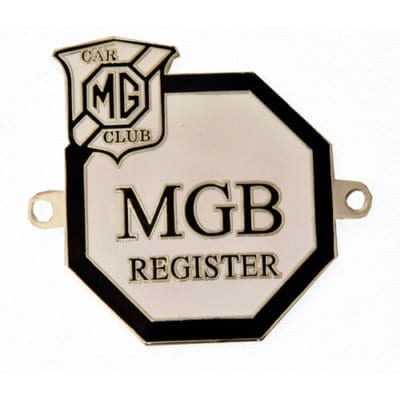
MGB Register Grille Badge
MGB Register Grille badge, which will come with all the fixings
-
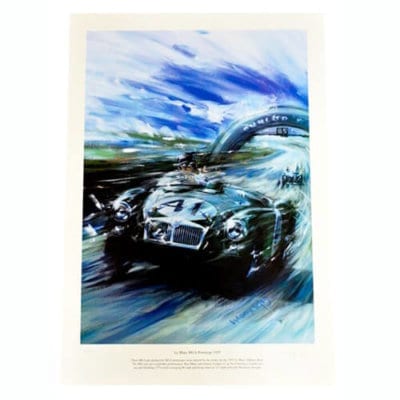
MGA At LeMans 1955 Print
Le Mans prototype MGA 1955, limited edition print by Claus Wagger.
Dimensions: 19″ x 15″ (49cm x 39cm)
-
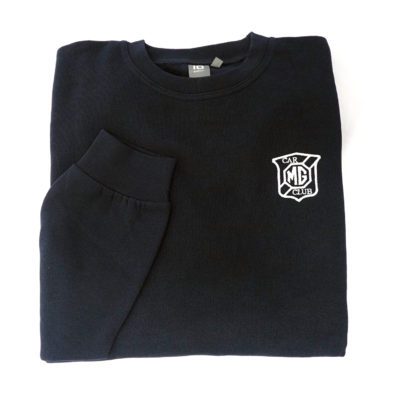
MGCC Classic Sweater
Our popular GAME sweatshirt with round neck. Double stitching and ribbing on collar, and ribbing on sleeves and at the bottom.
Embroidered with the MG Car Club logo with silver thread.
Soft, brushed inner fabric.
- 70 % COTTON/30 % POLYESTER
-

SVW Windscreen badge
We have redesigned our windscreen badge incorporating the famous Crosby picture of an SA at speed.
This measures 12cm x 7cm.
-

MG Benji Racing Driver
Our MG Car Club mascot
MG Benji in his MG Car Club Racing driver overalls. Limited edition of 251 pieces
-
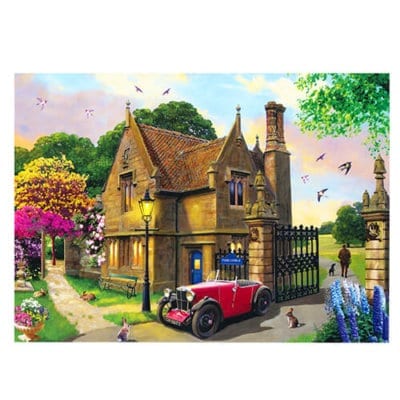
Park Lodge
Left blank inside for your own message.
Produced by Rothbury Cards using a design by Kevin Walsh.
-

AA to the Rescue
Left blank inside for your own message.
Produced by Rothbury Cards using a design by Kevin Walsh.
-

MGF/TF Restoration Manual
MGF/TF Restoration Manual provides the MGF/TF owner with a complete workshop guide to mechanical and body restoration for the cars. It shows the reader how to assess a car’s condition and breaks each task down into step-by-step photography and instructions, from minor repairs and maintenance procedures to a full engine strip and rebuild.
-
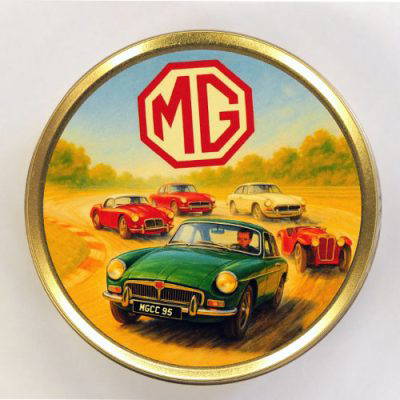
MGs on Track travel sweets
Old fashioned Travel sweets
Mixed fruit drops. Ingredients: Sugar, glucose syrup, citric acid E330, Natural flavours, natural colours E163, E160c, E100, E141.
Nutritional information per 100g. Energy 1710kJ/403kCal, Fat 0.0g of which saturates 0.0g, Carbohydrate 98g of which sugars 98g, Protein 0.6g, Salt 0.00g
-
RENEW – International Joint Digital Membership
A years membership of the MG Car Club.
Includes access to 11 online editions of the MG Car Club’s award-winning magazine, Safety Fast! viewable in the members area of the website.
Each MG Car Club membership lasts for 12 months from the date of renewal.
Please refer to the product description below for more details on MG Car Club digital membership.
-
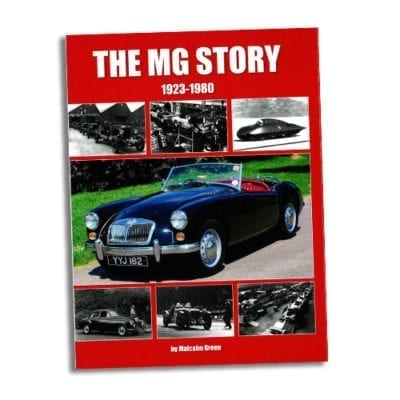
The MG Story 1923-1980
The first MGs were a small number of cars sold with special bodywork by Morris Garages, but by the 1930s the MG had come to be recognised as the archetypical sporting car. The rapid development of the marque, and the cars’ domination in their class of competition entry lists, is down to the energy, enthusiasm and skills of a small number of key personalities. Here, as well as in-depth studies of all models produced, there are biographies of those most involved with MG development, record breaking and motor sport. This book sets out to recount, in the form of a series of articles, the story of the marque from 1923 until the Abingdon factory closed in 1980. At that time this small market town housed what was probably the world’s largest producer of sports cars. Many of the competition efforts by both factory-supported entries and private owners are covered in detail and help show why MGs became so well known. To illustrate the text there are both black-and-white archive photographs from the author’s collection and a great many modern colour pictures of restored cars. Period advertising material has also been included. The wide range of topics covered gives the reader a real insight into the evolution of the company and its cars, and into the unique character of MGs that is the reason why they remain so popular.
-
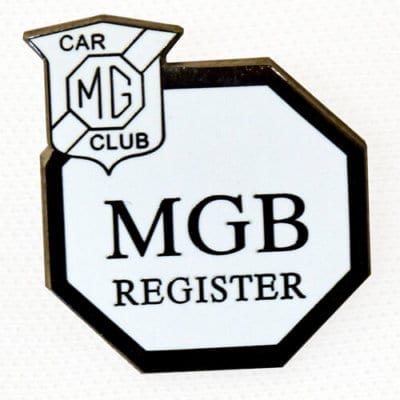
MGB Register Lapel Pin
MGB Register Lapel pin
-
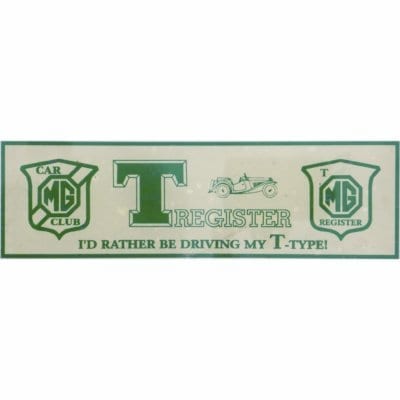
T register sticker
A rear window sticker for your ‘Eurobox’!
-

Happy Days in the Highlands
Left blank inside for your own message.
Produced by Rothbury Cards using a design by Kevin Walsh.
-
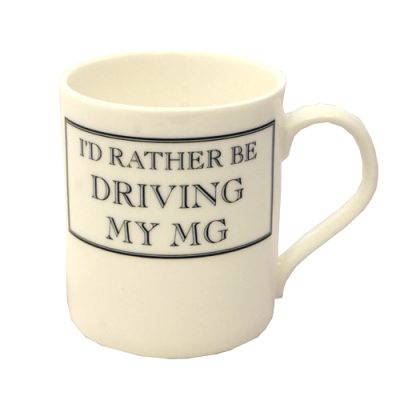
I rather be driving my MG mug
Bone China large mug 50ml, with dark green writing
-

NEW – European Single Membership
12 month membership of the MG Car Club.
Includes 12 copies of the MG Car Club’s award-winning magazine, Safety Fast!
Each MGCC membership lasts for 12 months from the date of joining.
Please refer to the product description below for more details on MG Car Club membership.
-
RENEWAL – International Joint Membership
Joint Membership Renewal to the MG Car Club.
As well as twelve issues of our award winning Safety Fast! magazine, and becoming a member of your local Centre and Register for your MG(s), MG Car Club membership can save you money on insurance, tickets, parts and much, much more.
-
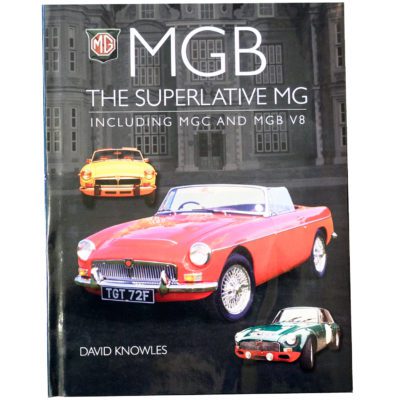
MGB – The Superlative MG
The MGB was a great British success story, a product largely conceived, designed and produced by a small team of dedicated people who genuinely cared about their work. Of course, the MGB came from a proud, successful sports car tradition, and the model it replaced – the revolutionary aerodynamic MGA – had been an unprecedented success – so the new car had big shoes to fill. Launching in 1962 and in production for eighteen years, the MGB became one of the most successful sports cars the world has ever known. This book describes how the MGB arose principally from the ideas of one man, MG’s Chief Engineer, Syd Enever, how it was designed and developed, how it survived and thrived, and how it became the classic car still highly regarded today. There have been many previous books about the MGB, and the related MGC and V8 variants, but MGB – The superlative MG reaches a new level of detail together seasoned with fresh insight. David Knowles has been researching and writing about the MGB for more than thirty years. Prepare to be surprised at some of the stories you will have never read before, and new twists on some you possibly thought you knew well.
-
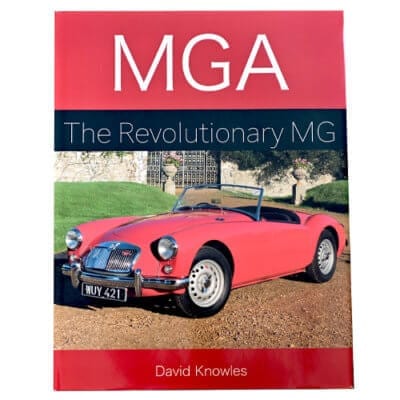
MGA The Revolutionary MG
The MGA truly marked a revolution in MG sports car design, with its appearance quite unlike any previous production car from the celebrated British marque. Entering production in the summer of 1955, it broke with the time-honoured tradition of narrow-gutted, flat-sides, upright styling, with the distinctive large grille, exposed headlamps, separate wings and sharply cut-off tail that had serviced the majority of MG sports cars for well over thirty years. Many die-hard MG enthusiasts of the time were understandably outraged, but the decision to break with tradition proved to be a good one: over 100,000 cars were produced over the model’s seven-year lifetime.
This book from celebrated author David Knowles covers:
- The circumstances that led to the momentous decision to make such a fundamental design change
- The production, publicity and evolution of each and every MGA variant from launch in 1955 to the end of production in 1962, with specification tables for each model
- The largely untold story of overseas assembly in Australia, Ireland, Mexico and South Africa
- Profiles of the people who had crucial roles in the development of the MGA, with input from many of the individuals and their families
- Comprehensive coverage of racing and rallying in Europe, including the MGA entries at Sebring Twelve Hour race and where many of the cars ended up
-

MG Midget card
From the MG Car Club archive, incl. envelope – left blank for your own message


